Deploying DokuWiki on Amazon Elastic Container Service (ECS) – Part 2 of 2
How to move on from a “Click-Ops” deployment via the AWS console to an Infrastructure as Code (IaC) deployment using Terraform.
If ECS feels harder than it should, the issue is rarely ECS itself.
We help teams design, deploy, and manage ECS clusters that hold up over time, across teams, workloads, and environments.
Amazon Elastic Container Service (ECS) is a managed container orchestration platform within Amazon Web Services (AWS). It allows teams to deploy, manage, and scale containerized applications without running their own orchestration control plane.
It is a practical choice for teams that are already operating on AWS and looking for a straightforward way to run web applications, APIs, and background services in containers.

Clear cluster design, predictable networking, and consistent deployment patterns reduce outages and failed releases.

Defined IAM boundaries, controlled network access, and vulnerability management improve auditability and reduce risk.

Right-sizing and scaling policies help balance EC2 instances and serverless compute usage based on workload behavior.

Your team spends less time troubleshooting infrastructure and more time working on application changes and improvements.
Our engagement models are designed to reduce risk and provide clarity early. Whether the need is a focused fix or longer-term AWS ECS support, our approach emphasizes clear scope, visible progress, and practical handoff.
We deliver:
With our AWS GovCloud support services, your systems will behave the way they were designed to behave, and compliance requirements remain intact as workloads change.
Our AWS ECS consulting services are most effective when they complement an existing team, rather than replacing it. We work best with organizations that want structured, dependable container platforms without turning ECS into a full-time internal burden.
If your organization:
SMS is the partner you need.
Our services are a strong fit for teams operating in environments where reliability, security, and auditability matter as much as delivery speed.

How to move on from a “Click-Ops” deployment via the AWS console to an Infrastructure as Code (IaC) deployment using Terraform.

The experts have all weighed in and Amazon Elastic Kubernetes Service (EKS) is the only option worth considering.
AWS container management solutions, including the Amazon ECS service, help teams deploy and manage containerized applications without running their own orchestration infrastructure. ECS reduces operational overhead by handling scheduling, service health, and integration with core Amazon Web Services like IAM, VPC, and load balancing. This makes it easier to deploy, manage, and scale applications consistently across environments.
Security for containerized applications on AWS starts with properly designed IAM roles, network isolation, and controlled access to resources. AWS ECS support should include scoped task roles, private networking, encrypted communication, and vulnerability management for container images stored in Amazon ECR. Continuous monitoring and clear audit trails further reduce risk, especially in regulated environments.
Amazon ECS provides developers with managed container scheduling, native integration with AWS services, and flexible compute options. Developers can choose between the EC2 launch type for greater control over virtual machines or the Fargate launch type for serverless compute.
ECS also integrates with CI/CD pipelines, service discovery, logging, and monitoring tools used for modern web applications.
Compared to other container orchestration platforms, ECS prioritizes simplicity and deep integration with Amazon Web Services. It does not require managing a separate control plane and aligns closely with existing AWS networking, security, and identity models.
For teams already operating on AWS, managing ECS is often more straightforward than maintaining additional orchestration layers.
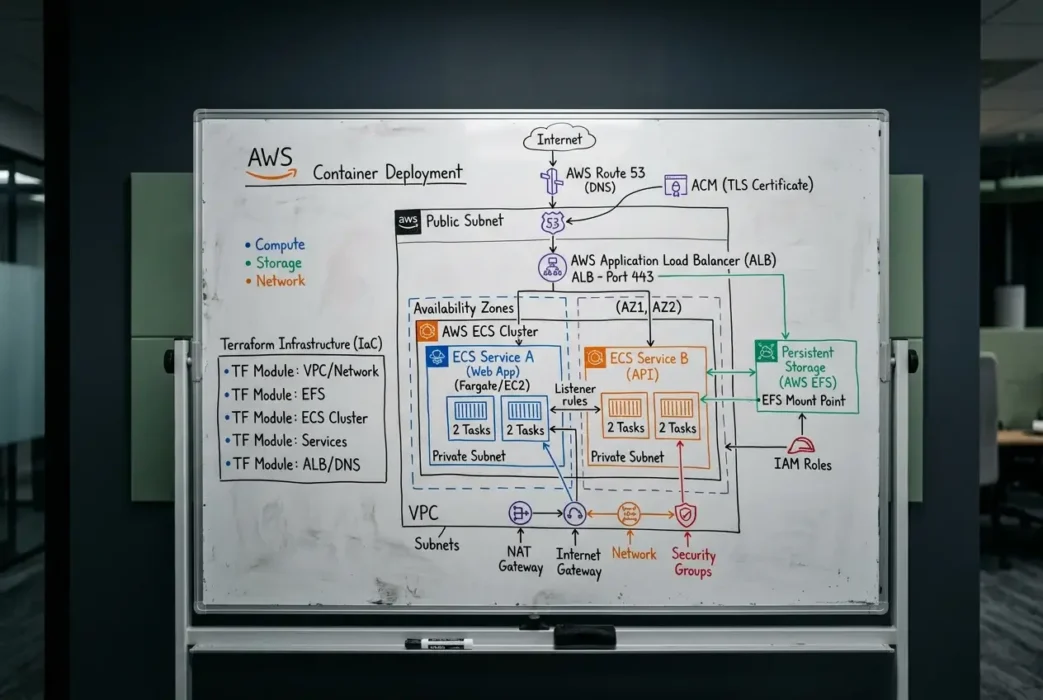
Best practices for deploying applications on Amazon ECS include designing resilient ECS clusters across multiple availability zones, using Infrastructure as Code, implementing automated CI/CD pipelines, and aligning scaling policies with real workload demand.
Strong AWS ECS support also includes clear IAM boundaries, consistent container image management in Amazon ECR, and monitoring that supports long-term cluster management.