The AI Boom and the Evolution of Hardware
We’re in the middle of a seismic shift in computing, driven by the explosion of AI. But behind the scenes of this AI revolution lies a less flashy but equally crucial transformation: the evolution of the hardware that makes it all possible.
From CPUs to GPUs: Why the Shift?
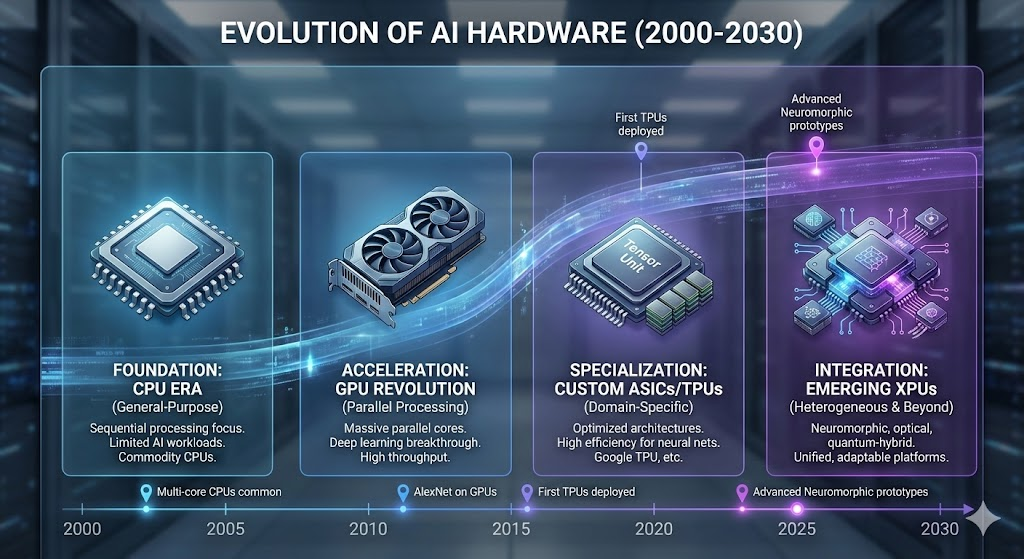
For decades, CPUs (Central Processing Units) were the heart of computing. They’re great at handling a wide variety of tasks; your laptop, phone, and most servers still rely heavily on them. But when AI workloads entered the picture, especially deep learning, CPUs hit a wall. The reason? AI training requires massive amounts of parallel computation, something CPUs just aren’t optimized for.
Enter GPUs (Graphics Processing Units). Originally designed for rendering video game graphics, GPUs can run thousands of threads in parallel. This made them the perfect fit for AI workloads, which thrive on matrix multiplications and massive datasets. NVIDIA’s early investment in CUDA (Compute Unified Device Architecture) and deep learning paved the way, and soon GPUs became the default for machine learning practitioners everywhere.
ASICs TPUs, XPUs “Oh My”: Hardware with a Purpose
GPUs aren’t the end of the story. As AI models get bigger and more specialized, so does the need for purpose-built hardware. That’s where ASICs (Application Specific Integrated Circuits) come in. ASICs are designed to do one thing well. Cisco, for example, has long used ASICs in networking hardware to accelerate specific tasks like packet forwarding at lightning speeds.
Google took this concept and ran with it, developing TPUs (Tensor Processing Units). These are essentially AI-focused ASICs, engineered specifically to speed up neural network computations. TPUs don’t try to be everything a GPU or CPU can be but are laser focused on AI workloads and deliver massive efficiency gains in those areas.
Broadcom has their own take with XPUs which are the XDSiP platform. These specialized chips function as an integrated solution, combining GPU, CPU, and memory on a single platform with customer-specific ASICs that tie everything together for specialized workloads. Broadcom’s XPU architecture provides significant performance advantages for AI inference and training by optimizing data movement between components, reducing latency, and increasing throughput. The unified memory architecture allows for more efficient processing of complex AI algorithms without the bottlenecks typically encountered when data needs to move between separate components. This approach has proven particularly effective for telecommunications, networking, and enterprise applications, where Broadcom’s success in these other markets and technologies made them an obvious choice for building new hardware specific to AI.
Hyperscaler Solutions: More Chips More Choices
The big cloud players like AWS, Google Cloud, and Azure are doubling down on custom silicon. AWS has its Trainium and Inferentia chips, Google has their TPUs as mentioned before, and Microsoft is building its own AI accelerators under the Azure umbrella. These hyperscalers are competing not just on storage or compute, but on how efficiently and quickly they can run AI models.
They’re also building out hybrid options, letting enterprises extend cloud native tools into their own datacenters.
On-Prem AI: 3 Paths for Enterprises
For organizations looking to keep AI workloads in-house whether for control, cost, or compliance there are a few entry points:
- Prepackaged AI Appliances Think NVIDIA DGX or HPE Cray. These are plug-and-play systems designed for AI, complete with optimized software stacks.
- Modular AI Infrastructure Companies like Cisco offer AI ready servers where you can pick and choose the exact mix of CPUs, GPUs, and networking components to meet your needs.
- Custom-Built Clusters For those with the expertise, fully customized clusters using off the shelf components (and maybe some open-source orchestration tools like Kubernetes, Slurm or Ray) give you maximum flexibility and control.
Why On-Prem Still Matters: Security First
While the cloud is great for flexibility and scale, on-premises AI still has its place. Especially for organizations where data security and sovereignty are nonnegotiable. Industries like big pharma, nuclear energy, and the Department of Defense can’t afford to let sensitive data leave their walls. For them, on-premises solutions provide peace of mind, tighter integration with existing infrastructure, and often meet compliance requirements that public cloud simply can’t. Supply issues are also something to contend with on hyperscalers. Due to the popularity of GPUs and the way they inherently work compared to CPUs, manufacturers were having a hard time keeping up with demand. Additionally, Fortune 500s have so much demand that these hyperscalers can’t keep up.
What’s Next? Emerging Hardware Approaches
We’re seeing all kinds of innovations in the hardware space right now. Neuromorphic computing (which mimics the way the brain works), optical computing (using light instead of electricity), thermodynamic computing (harnessing entropy and energy dissipation for computation), and quantum computing (still early, but promising for certain AI tasks) are all being tested.
There’s also a push to bring AI capabilities to the edge, meaning hardware that’s optimized not just for the cloud but for running inference right on devices like phones, drones, and IoT sensors. This includes chips like Apple’s Neural Engine or Qualcomm’s AI processors.
Final Thoughts
As AI continues to evolve, so will the hardware underneath it. The winners will be those who understand not just the models and algorithms, but the silicon that makes them run. Whether you’re in the cloud, on-premises, or somewhere in between, the future is being shaped not just in code but also in chips.
If you are struggling to decide on the right path forward, SMS has a team ready to assist and guide you throughout your journey.